
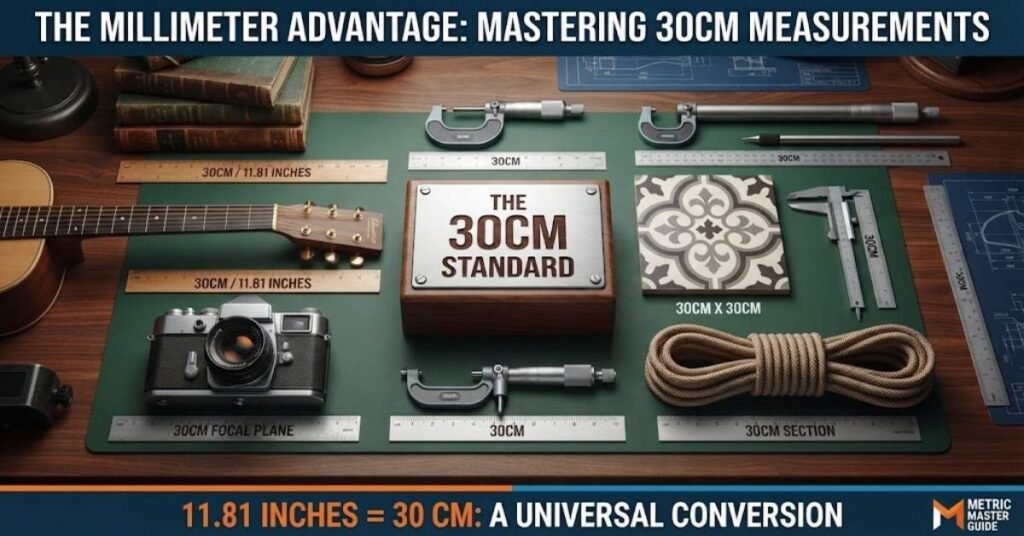
So you typed “30 cm in inches” into Google and you want a straight answer, not a lecture. Here it is: 30 cm equals 11.81 inches. That’s the number. Round it to 11.8 if you’re eyeballing something at home, or keep the full decimal if you’re cutting wood or ordering a part online.
But a number alone doesn’t tell you much, does it? You can’t picture 11.81 inches just by hearing it. That’s why this guide pairs the conversion with 12 things you’ve probably touched this week, things that sit right around 30 centimeters in length or width.
By the end, you won’t need a ruler or a measuring tape to guess this size again. You’ll just remember the pizza.
30 cm: Every Conversion You Actually Need
Let’s get every unit out of the way in one shot, because switching between the metric system and the imperial system shouldn’t take five browser tabs.
30 cm breaks down like this: it’s 11.81 inches, 0.984 feet, 0.3 meters, and 300 millimeters. If you’re working in yards, that’s roughly 0.328 yd, small, but not nothing when you’re measuring fabric or garden beds.
For anyone dealing with screens or design files, 30 cm also maps to pixel values depending on your DPI setting. At 72 DPI (standard web resolution), 30 cm comes out to about 850 pixels. Bump it to 96 DPI and you’re near 1134 pixels. Print work at 300 DPI pushes that to roughly 3543 pixels. This matters more than people expect when resizing images for print versus screen.
Why 30 cm Keeps Showing Up Everywhere
Here’s something nobody tells you: 30 cm isn’t a random number. It’s close enough to one foot that manufacturers in Europe and Asia often round product dimensions to this mark instead of using an odd imperial figure.
That’s why you’ll spot it constantly in product listings, size charts, and shipping box labels. A shelf bracket, a storage bin, a display stand, they all cluster around this size because it’s a clean, practical size for both metric and near-imperial buyers.
Once you know this, size guessing on online shopping sites gets a lot less stressful. You stop guessing and start recognizing.
12 Everyday Things That Are Right Around 30 cm
Numbers fade from memory fast. Objects don’t. Here are 12 everyday household items that hover close to 30 centimeters, so the next time you need a size comparison, you’ve got a mental shortcut ready.
1. A Medium Pizza
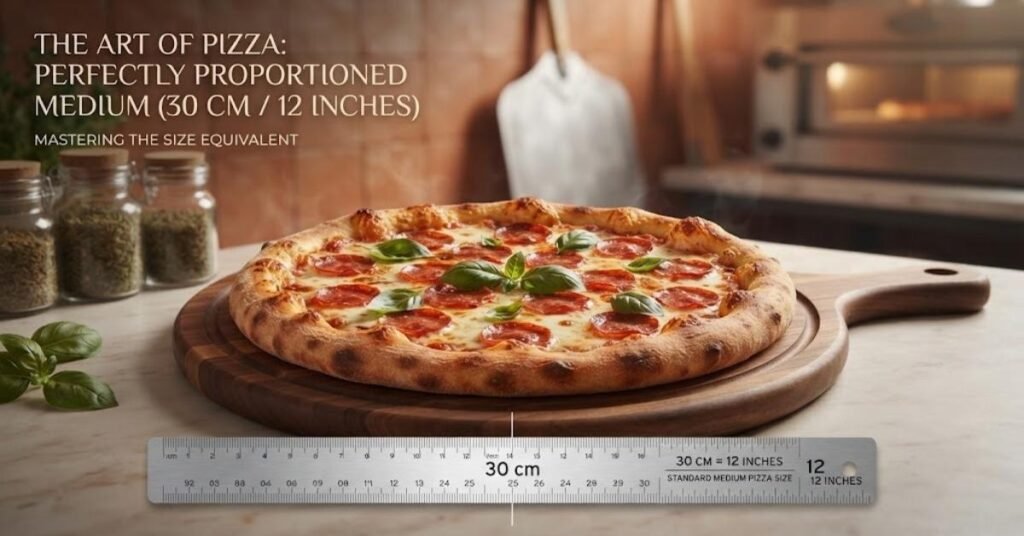
A medium pizza typically runs about 12 inches across, which lines up almost exactly with our pizza diameter target. Slide one into your oven rack and you’ve basically got a live 30 cm ruler sitting in front of you.
Next time a pizza box shows up at your door, glance at the width before you dig in. It’s a surprisingly reliable real-life size reference for anything close to a foot wide.
2. A Standard Plant Pot (Medium Size)
Walk into any garden center and you’ll find a 30 cm diameter plant pot on nearly every shelf. It’s the go-to planter size for a mid-grown houseplant, think a leafy monstera or a young citrus tree that’s outgrown its starter pot.
Gardeners rely on this size constantly because it balances root space with something you can still lift. If you’ve ever repotted a plant and reached for “the medium one,” you’ve handled 30 cm without knowing it.
3. A Vinyl Record (LP)
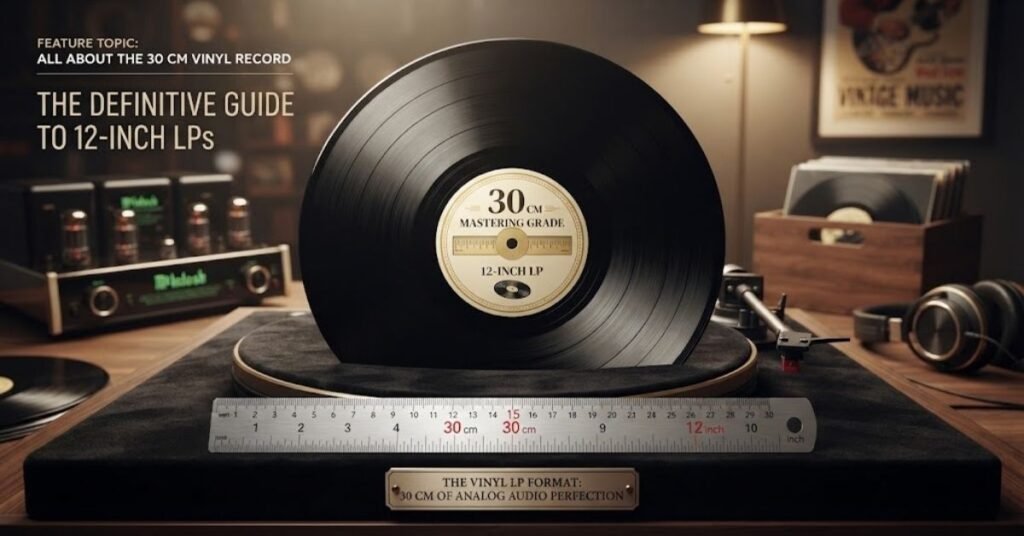
Music fans already know this one. A classic vinyl record, the 12-inch record format, sits just under 30 cm across, sleeve and paper label included.
Hold an LP record up next to a ruler sometime. It’s one of the most precise, unchanging object comparison examples out there since the format has stayed fixed for decades.
4. A Round Side Table
Furniture shoppers run into this constantly. A round side table, the kind you’d tuck beside a sofa or use as a bedside table, often measures close to 30 cm across the top.
Browse IKEA or any furniture store and you’ll notice this size repeating across different collections. It’s compact enough for tight apartments but still wide enough to hold a mug and a book.
5. A Guitar Neck (Full Length from Nut to Body)
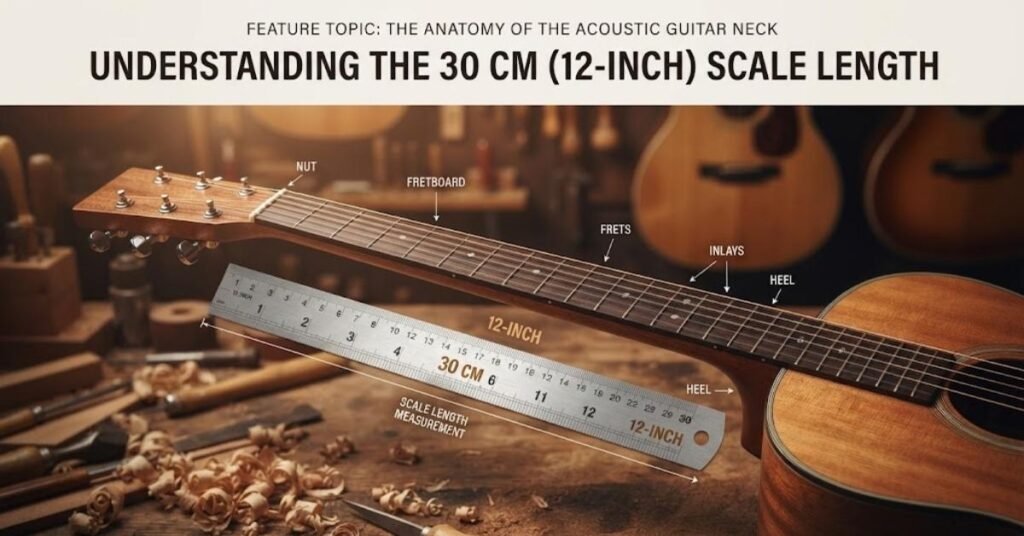
Musicians, here’s one for you. On many acoustic guitar and electric guitar models, the guitar neck length, measured from the nut to where it meets the guitar body, lands right around this mark.
It’s not exact across every brand, but if you’re describing neck length to someone over the phone, “about a foot” gets the point across fast.
6. A Standard Floor Tile
Construction folks deal with this daily. The 30 × 30 cm tile is one of the most common sizes for bathroom tiles and kitchen tiles, especially in an entryway or utility space.
Ask any tiler or interior designer and they’ll tell you this size shows up on nearly every job. It’s a staple in the construction industry for a reason: easy math, easy layout.
7. A Newborn Baby’s Length at Birth (Roughly Half)
This one surprises people. A newborn baby‘s birth length is usually 48 to 53 cm, so 30 cm roughly covers from the head down to around the ribcage.
It’s a strange but oddly useful physical reference for new parents trying to picture growth charts without overthinking the numbers.
8. A Standard PVC Pipe Section (Common Cut Length)
Head to any hardware aisle and you’ll find PVC pipe section cuts sold around this length for smaller plumbing jobs. It’s common in drainage system repairs, irrigation system setups, and general DIY projects where you just need a short connector piece.
Pair it with a few pipe fittings and you’ve got a workable repair length without buying a full-size pipe.
9. A Typical Skateboard Deck Width (Times Two)
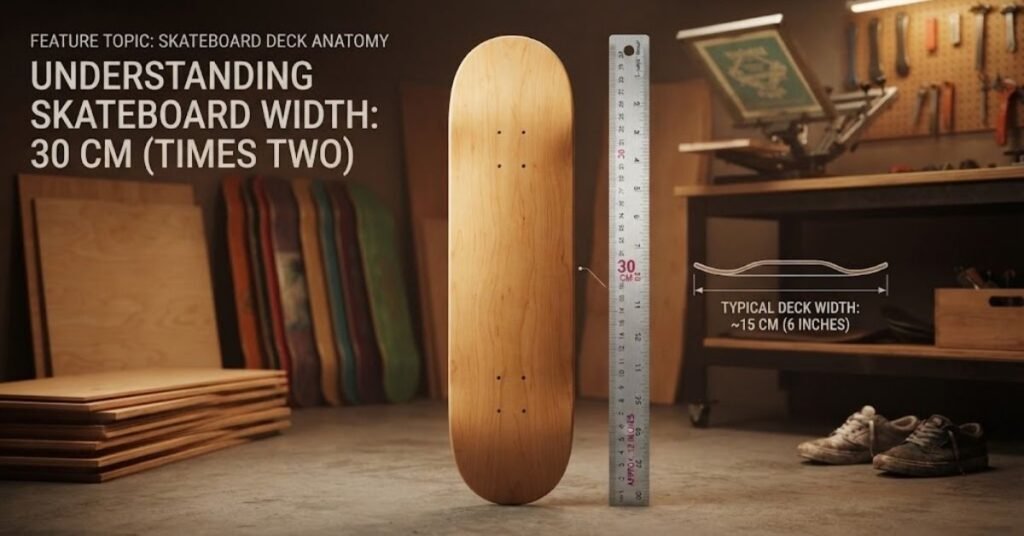
A single skateboard deck width runs around 20 cm, so doubling that gets you close to our target. It’s not a direct match, but skaters often use deck width as a mental measurement guide when estimating other gear.
If you skate, you already eyeball distances like this without a second thought.
10. A Large Dinner Candle Holder (Plate Style)
Some decorative tray style candle holder sets, the kind used as a centerpiece on a dining table, stretch close to 30 cm across. They’re built wide enough to hold multiple candles without crowding your dinner plate setup.
Next time you’re setting a table for guests, that centerpiece tray might be your unofficial ruler.
11. A Standard Badminton Racket Handle
A badminton racket handle, combined with part of the shaft, often measures near this length. The sport is massive across South Asia and Southeast Asia, and racket grip sizing gets discussed constantly among players comparing gear.
If you’ve ever held a racket and thought “that feels like about a foot in my hand,” you were right.
12. A Standard Bathroom Faucet Spout Reach
Last one, and it’s genuinely useful for home renovators. A bathroom faucet spout reach, from the base of the faucet assembly to the tip, commonly measures close to 30 cm on wider vanity installations.
Anyone shopping for bathroom accessories or bathroom fixtures during a home improvement project runs into this spec sheet number often.
30 cm in Inches and Feet: Quick Math Reference
Sometimes you just need the shortcut math without objects or explanations. Here’s your quick math reference, plain and simple.
- 30 cm to inches: multiply cm by 0.3937, giving you 11.81 inches
- 30 cm to feet: divide inches by 12, landing at 0.984 feet
- 30 cm to meters: shift the decimal, giving you 0.3 meters
- 30 cm to millimeters: multiply by 10, giving you 300 millimeters (mm)
- 30 cm to yards: divide meters by 0.9144, giving roughly 0.328 yd
Keep this conversion chart bookmarked if you deal with product dimensions often. It saves you from redoing the same measurement conversion every single time you shop online.
30cm Diameter: What That Actually Means
People mix up diameter and radius constantly, so let’s clear it up. If something has a 30cm diameter, that’s the full straight line across the middle of a circle, edge to edge, not the distance from the center out.
The radius would be half that, 15 cm. And if you needed the circumference, you’d multiply the diameter by pi, landing around 94.2 cm. For area, you’d use the radius squared times pi, giving you roughly 706.5 square centimeters.
This matters more than it sounds like when you’re buying a round objects item, say a circular object like a table top or a lid for a container. A 30cm diameter lid needs a container opening that matches that full width, not the radius. Mixing these up is one of the most common ordering mistakes in online shopping.
Is 30 cm the Same as 12 Inches?
Close, but not exact. 12 inches equals precisely 30.48 cm, while 30 cm equals 11.81 inches. The gap is small, under half a centimeter, but it matters in fields where precision measurement counts, like precision cuts for shelving or picture frames with fixed slots.
For rough, everyday guessing, calling 30 cm “almost 12 inches” or “one foot” works fine. For anything involving cutting materials or manufacturing tolerances, use the exact centimeter-to-inch conversion instead.
How to Estimate 30 cm Without a Ruler
No measuring tape nearby? You’re not stuck. Try these estimation without ruler tricks that most people already carry with them.
- A sheet of A4 paper is 29.7 cm long, basically a perfect stand in for 30 cm
- The distance from an average adult’s elbow to wrist runs close to this mark
- Stretch your forearm out flat and it often lands near the same length
- Spread an adult hand width across knuckles twice and you’re roughly there
- A standard kitchen counter depth is often close to double this measurement, so half the counter gives you a rough gauge
These approximate measurement tricks won’t replace real tools for serious projects, but for quick, practical measurements around the house, they get the job done.
Where This Conversion Actually Matters in Real Life
Beyond curiosity, this exact figure shows up constantly in situations people don’t expect.
Shopping for a car tire sidewall spec, checking a windowsill before buying blinds, or comparing furniture dimensions before a move, all of these lean on quick household measurement instincts. Even waist measurement charts for clothing sometimes reference this range for smaller sizing brackets.
Because so many manufacturers build around metric standards, especially those exporting from Europe and Asia, this number keeps resurfacing across garden supplies, tech products, and general home décor. Once you notice it, you’ll start seeing 30 cm everywhere.
FAQs
What is 30 cm equal to in inches?
30 cm equals 11.81 inches, or roughly 11.8 inches when rounded for everyday use.
Is 30 cm bigger than 12 inches?
No. 12 inches is slightly larger, equal to 30.48 cm, so 30 cm falls just under a full foot.
How many feet is 30 cm?
30 cm works out to 0.984 feet, essentially one foot minus a small fraction.
What household object is closest to 30 cm?
A medium pizza, a 12-inch record, or a standard floor tile are among the most reliable real-world examples for this exact length.
How do I convert cm to inches quickly in my head?
Multiply the centimeter figure by roughly 0.4 for a fast estimate. For 30 cm, that gives you close to 12, near enough for casual use, though the real conversion rounds to 11.81.
Why do product listings use 30 cm instead of exact inch measurements?
Because most manufacturers design around metric standards first, then let inch buyers do their own measurement conversion, which is exactly what this guide just handled for you.

Ethan Whitmore is the editor and administrator of Stylovix, dedicated to making measurements, conversions, sizes, and dimensions simple, accurate, and easy to understand.
