

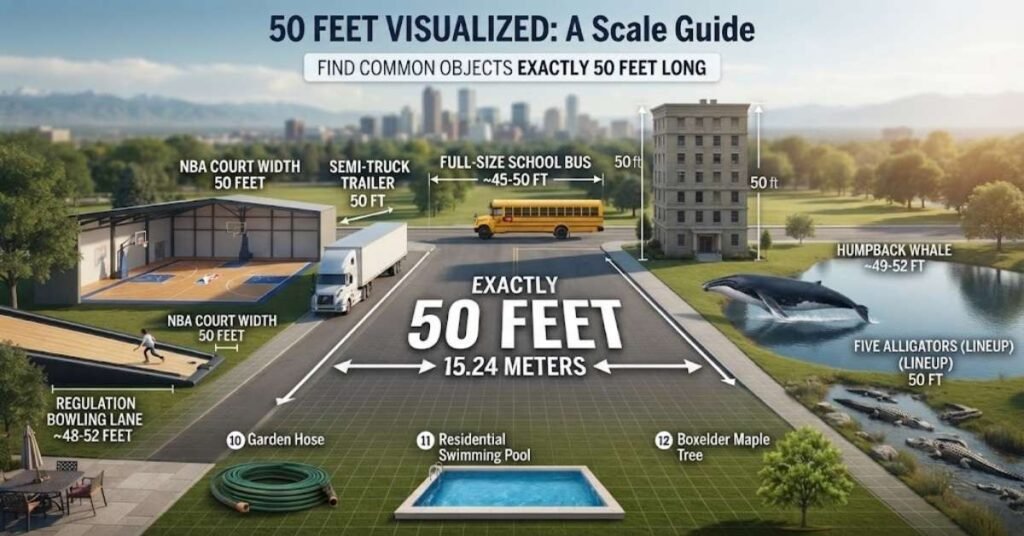
Ever tried picturing 50 feet in your head and just drawn a blank?
You’re not alone.
Most people can guess what a foot looks like. A mile too, sort of. But 50 feet? That’s the awkward middle ground. Too big for a tape measure, too small to compare with a football field.
Here’s the short answer: 50 feet is about the width of an NBA court, the length of a standard garden hose, or roughly the size of a full grown humpback whale. Stack ten adults head to toe and you’re close. Park three cars end to end and you’ve basically nailed it.
Now let’s expand on that, one real-world example at a time. By the end, you’ll never squint at a “50 feet” label again.
How Long Is 50 Feet?
Fifty feet equals about 15.24 meters, 600 inches, or 16.7 yards. In kilometers, it barely registers at 0.0152 km. So this isn’t a huge distance, but it’s not tiny either.
Think of it this way. If you’re an average adult, your height is around 5 to 6 feet. Lie down ten times in a row, head to foot, and you’ve covered 50 feet. That mental trick works better than any chart.
Here’s a quick conversion chart for reference:
| Unit | Value |
|---|---|
| Feet | 50 |
| Inches | 600 |
| Yards | 16.7 |
| Meters | 15.24 |
| Centimeters | 1,524 |
| Millimeters | 15,240 |
| Kilometers | 0.01524 |
| Miles | 0.00947 |
Keep that table bookmarked. You’ll want it again later.
Sports and Recreation: Things That Are 50 Feet Long
Sports fields are built on exact numbers, which makes them great visual reference points. Nobody’s guessing here. Every line gets measured and re-measured before a single game tips off.
That precision is exactly why coaches, broadcasters, and fans use these dimensions as mental yardsticks. If you’ve stood courtside once, you already have a built in sense of 50 feet.
NBA Basketball Court Width
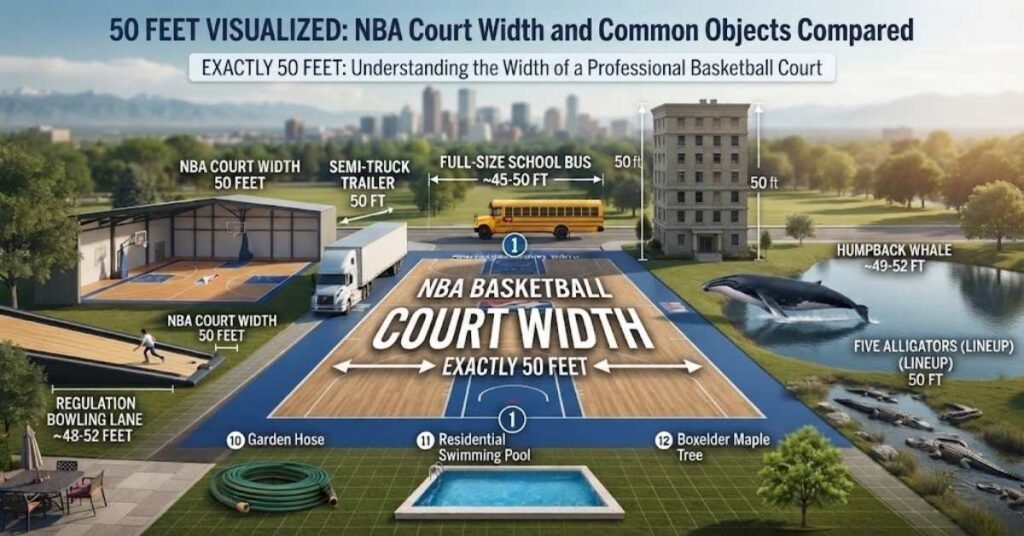
An NBA basketball court is 94 feet long and exactly 50 feet wide. That width runs sideline to sideline, the short direction you see when the camera pans during a broadcast.
This isn’t random. The National Basketball Association locked in that width decades ago, and it shapes everything from spacing to strategy. Wider player spacing on offensive plays means more room to drive. Tighter defensive formations rely on cutting that same width down fast.
Next time you watch a game, look at the sideline to sideline gap. That’s your 50-foot measurement, live and in motion.
Regulation Bowling Lane
Here’s where a lot of articles get sloppy, so let’s set the record straight. A regulation bowling lane measures exactly 60 feet from the foul line to the center of the headpin, according to the United States Bowling Congress (USBC).
So it’s not quite 50 feet, but it’s close enough that bowlers often use it as a mental placeholder. Shave off the 15 foot approach area where players take their steps, and the remaining pin deck section sits right around the 50 foot mark from a bowler’s release point.
Either way, next time you’re at the bowling alley, you’re standing in a space engineered down to fractions of an inch. That’s the kind of indoor reference most people never think twice about.
Vehicles and Transportation: Objects That Are 50 Feet Long
Vehicles give you a moving, rolling version of 50 feet. You pass them on highways daily without ever clocking the actual size.
Once you know the numbers though, you start noticing. That eighteen wheeler in your rearview mirror? It’s basically half a basketball court on wheels.
Full-Size School Bus
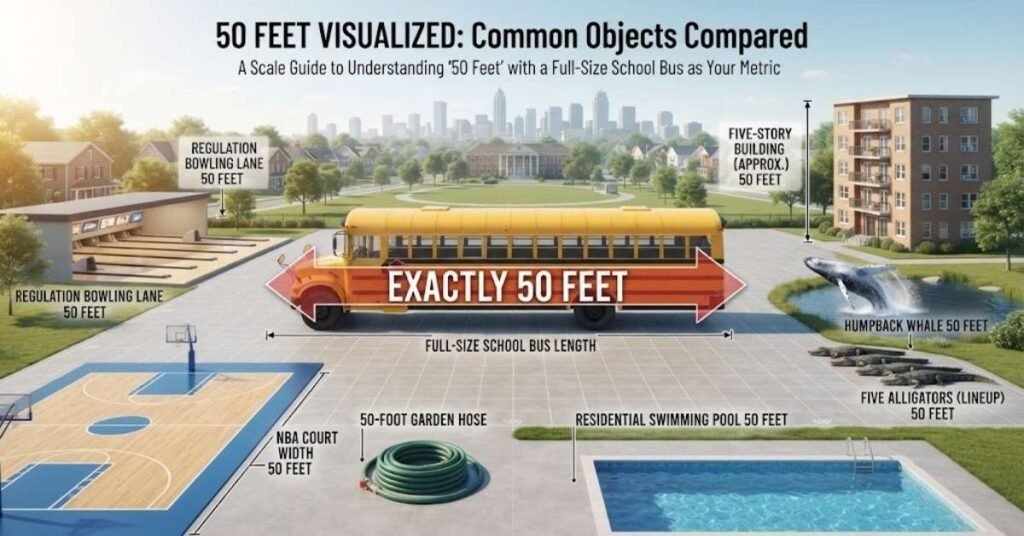
A full-size school bus, specifically the Type D or transit-style school bus, typically runs between 35 and 45 feet long. It doesn’t quite hit 50 feet, but it gets impressively close on the larger end.
The National Highway Traffic Safety Administration (NHTSA) sets safety standards for these vehicles, and most school districts pick the size based on route needs and student headcount. Bigger buses carry more kids but need wider turning space.
So while it’s not exactly 50 feet, a max-length school bus gives you a solid visual stand in. Picture one parked outside a school, then imagine adding another 5 to 10 feet. That’s your 50-foot object.
Semi-Truck Trailer
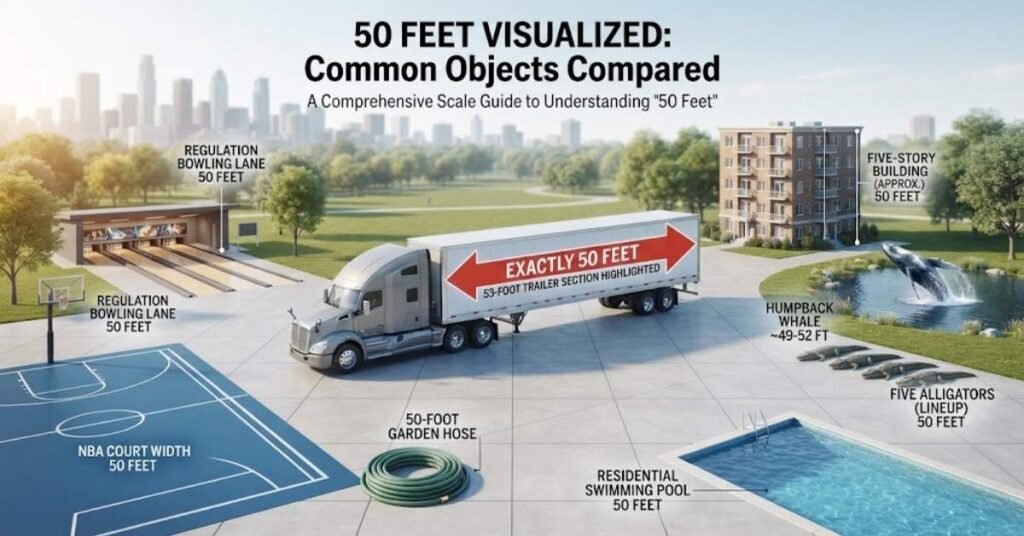
Now here’s one that nails it almost perfectly. A standard semi-truck trailer, the kind hauling freight down interstate highways, measures either 48 or 53 feet, based on Federal Highway Administration rules under 23 CFR Part 658.
That 48 foot version sits shoulder to shoulder with our 50-foot theme. Pull into any distribution center or highway rest stop and you’ll see rows of these cargo trailers lined up like dominoes.
Next road trip, count the seconds it takes to pass one at highway speed. You’re clocking roughly 50 feet of steel in about a second flat.
Buildings and Structures: How 50 Feet Looks in Height
Height changes the whole feel of a measurement. Fifty feet lying flat feels manageable. Fifty feet standing straight up? That’s a different story entirely.
Buildings translate this vertical version of the 50-foot measurement into something you walk past constantly without noticing.
A Five-Story Building
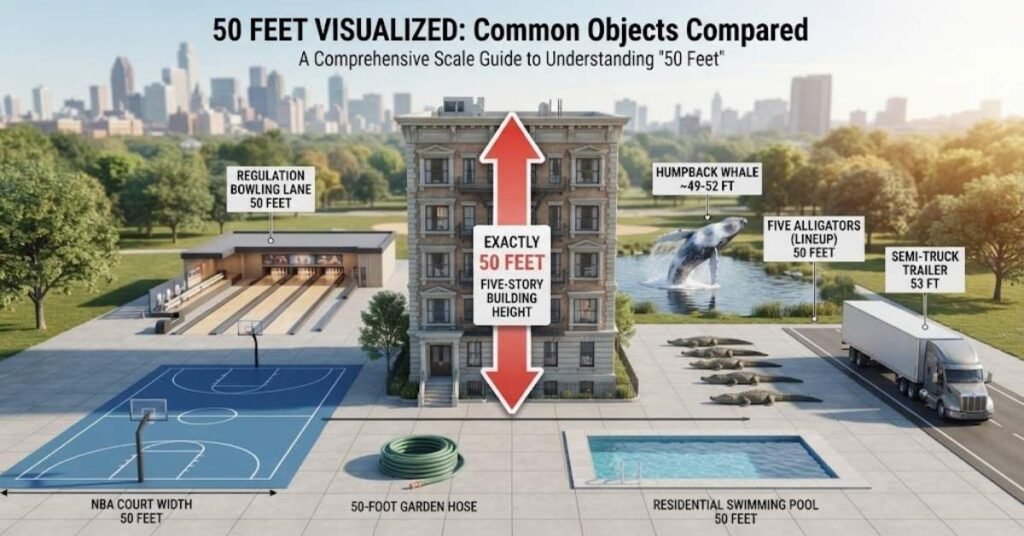
Most commercial buildings and residential buildings average 10 to 12 feet per floor, once you count ceiling height plus the structural framework between levels. Multiply that out and a five-story building lands right around 50 feet tall.
That’s roughly the height where rooftop views start feeling genuinely high up. Not skyscraper territory, but enough that a fall would seriously hurt, and enough that the street below looks noticeably smaller.
If you’ve ever looked up at a five story apartment complex and wondered “how tall is that thing,” now you know. You’re looking at 50 feet of building height, give or take a few feet depending on design.
The Hollywood Sign Letters
The famous Hollywood Sign perched in Griffith Park, overlooking Los Angeles, features letters standing 45 feet tall. That’s just shy of our 50-foot benchmark, but visually, from a distance, it reads as even taller thanks to the steep hillside behind it.
Built into the Santa Monica Mountains, this landmark has become shorthand for the entertainment industry itself. Tourists hike up near the Griffith Observatory just to get a closer look at the scale.
Stand at the base of one letter sometime. At 45 feet, you’re standing under something nearly as tall as our full 50-foot comparison point, and it genuinely feels massive up close.
Nature and Animals: Living Things That Reach 50 Feet Long
Nature doesn’t care about round numbers, but a surprising number of creatures land shockingly close to 50 feet. These aren’t estimates pulled from thin air either. NOAA Fisheries and wildlife agencies track these lengths closely.
Humpback Whale
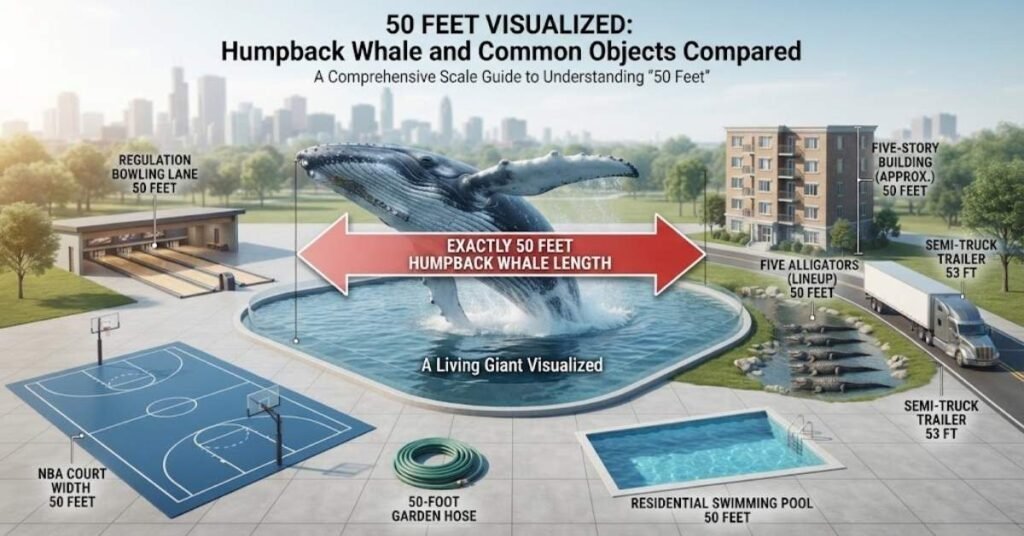
An adult humpback whale typically measures between 39 and 52 feet, depending on gender and location. Females tend to run larger. Populations in the North Atlantic and North Pacific both hit the upper end of that range regularly.
If you’ve ever gone whale watching off either coast, you’ve likely seen one close to our target length. Researchers aboard research vessel trips measure these giants using photographic techniques, comparing body length against known reference points on the boat.
It’s wild to think something living in the Pacific Ocean casually matches the width of an entire NBA court.
Grey Whale
The grey whale, also spelled gray whale, comes in slightly smaller but still impressively close, averaging 43 to 50 feet as full grown adults. These marine mammals migrate along the Pacific coastline every year, covering thousands of miles between feeding and breeding grounds.
Scientists monitoring these migrations often reference the 50-foot mark as a rough ceiling for a healthy, mature grey whale. It’s one of the more reliable natural benchmarks out there.
Five American Alligators End-to-End
Here’s a fun one that requires a little math. The American alligator averages roughly 10 to 12 feet in length as an adult male, according to the Florida Fish and Wildlife Conservation Commission and the Louisiana Department of Wildlife and Fisheries.
Line up five of them nose to tail, and you’ve got yourself a solid 50-foot stretch. You’ll find healthy populations across Florida, Louisiana, Georgia, and South Carolina, mostly tucked into wetlands throughout the southeastern United States.
Not something you’d want to test in person, obviously. But as a mental image, five alligators in a row makes the number stick.
Home and Everyday Items: 50 Feet in Your Own Backyard
You don’t need a whale or a stadium to find 50 feet. It’s probably sitting in your garage or backyard right now.
Standard 50-Foot Garden Hose
This one’s about as literal as it gets. A 50-foot garden hose is one of the most common lengths sold at hardware stores, long enough to reach most corners of a suburban front yard or backyard without needing an extension.
Homeowners use these for everything from watering flower beds to rinsing off the driveway after a muddy weekend. If you’ve ever uncoiled one fully across your lawn, you’ve physically walked the exact length we’re talking about.
It’s the single easiest real-world example on this entire list. No conversion, no estimating. Just 50 actual feet of rubber and vinyl.
Residential Swimming Pool
A lap pool built for serious aquatic fitness often measures close to 50 feet, matching a shortened version of Olympic pool standards. You’ll find these more often in Florida, Arizona, and Texas, where suburban homes have the yard space and year round weather to justify them.
Pool contractors in these regions frequently pitch the 50 foot length specifically because it allows for real lap swimming, not just splashing around. It’s a popular upgrade for homeowners serious about home fitness.
Even a standard backyard pool without lap markings often stretches somewhere between 30 and 50 feet, putting our benchmark length well within normal landscaping plans.
Plants and Trees: Natural Growth That Reaches 50 Feet
Trees grow slowly, but they don’t stop climbing until genetics or the environment says otherwise. Several common species land right at our target height once fully mature.
Boxelder Maple Tree
The Boxelder Maple, scientifically known as Acer negundo, is a native tree found throughout North America, especially thriving in riparian zones near rivers and streams. At mature height, it typically reaches 30 to 50 feet, making it one of the more common shade trees in parks and green spaces.
Unlike ornamental trees bred for looks, the Boxelder grows fast and tough, tolerating poor soil and flooding better than most maples. You’ll spot them lining neighborhoods and riverbanks across much of the country.
Next walk through a local park, look for a wide canopy maple with pale bark. There’s a decent chance you’re standing under something that hit the 50-foot mark years ago.
More Everyday Comparisons Worth Knowing
Beyond the twelve core examples, a few more comparisons help lock in the scale of 50 feet for daily life.
Car Lengths Stacked Together
A mid-size sedan averages around 15 to 16 feet long. Line up just over three of them bumper to bumper, and you’ve hit 50 feet. Parking lots and driveways make this an easy mental check whenever you need a rough estimation without a tape measure.
Walking Time and Steps
For the average adult walking pace, covering 50 feet takes somewhere between 3 and 5 seconds at a normal stride length. In terms of actual footsteps, that works out to roughly 16 to 20 steps, depending on leg length and pace.
It’s not a long walking distance by any measure. You’d cross that space just moving from a parking spot to a store entrance.
Conclusion
Fifty feet stops feeling abstract once you attach it to things you already know. A basketball court’s width. A garden hose stretched across the yard. A humpback whale surfacing near a boat. These aren’t textbook numbers, they’re real-life measurement points anyone can picture instantly.
Next time someone mentions a 50-foot distance, length, or height, you’ll have an actual mental picture ready to go, not just a number floating without context. That’s the whole point of building a solid dimension reference in your head.
FAQs About Things That Are 50 Feet Long
How long is 50 feet visually?
Picture the width of an NBA court, or roughly ten adults lying head to toe in a row. That mental image beats any number on paper.
How many car lengths is 50 feet?
About three mid-size sedans parked bumper to bumper, give or take a few inches depending on the model.
How far is 50 feet to walk?
Around 3 to 5 seconds at a normal walking pace. It’s a short, quick distance, roughly the length of crossing a small room or two.
How many steps equal 50 feet?
Somewhere between 16 and 20 steps for most adults, depending on stride length and walking speed.
What animals are about 50 feet long?
Humpback whales and grey whales both come close, with humpbacks reaching up to 52 feet and grey whales averaging around 43 to 50 feet as adults.
How many stories high is 50 feet?
Roughly five stories, assuming an average of 10 to 12 feet per floor including ceiling height and structural elements.
How big is 50 feet compared to a human?
It’s about eight to ten times the height of an average adult, depending on individual human height.
Is 50 feet a long distance to walk?
Not really. It’s a short walking distance, comparable to crossing a driveway or a small parking area in under five seconds.

Ethan Whitmore is the editor and administrator of Stylovix, dedicated to making measurements, conversions, sizes, and dimensions simple, accurate, and easy to understand.
