
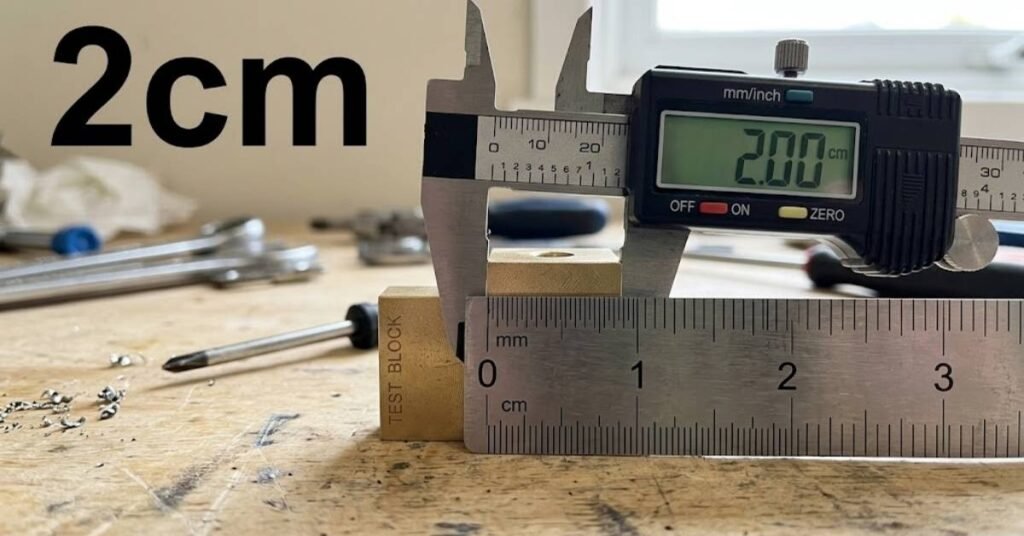
How big is 2 cm, and how can you picture it without a ruler? It’s about the width of a large paper clip, or roughly two green peas sitting side by side.Maybe you’re sizing a sticker, checking a screw, or helping a kid with homework. Numbers on a screen rarely help until you can see them in your hand.
That’s why this guide leans on everyday objects you already own. By the end, you’ll spot 2 centimeters the way you spot a dollar bill.Got a quirky 2 cm object of your own? Drop it in the comments, because the best examples usually come from readers.
How Big Is 2 cm?
Two centimeters equals 20 millimeters, 0.79 inches, 0.02 meters, and about 0.07 feet.
In the metric system, that’s a small slice of a ruler, just two numbered gaps.
Think of it as a bit less than an inch.
If you grew up with the imperial system, picture three quarters of an inch plus a hair.
Why does this size matter?
Because tiny length measurement errors add up fast in crafts, sewing, and packaging.
A 2 cm miss on a picture frame looks sloppy.
A 2 cm miss on a shoe size means sore feet.
Here’s a simple trick for size estimation.
Your thumb’s top joint, from knuckle to tip, often lands near 2 to 3 cm, so check yours against a ruler once and remember it.
Common Things That Are 2 cm
Nobody carries a measuring tool everywhere.
Your pocket, desk, and kitchen drawer carry plenty of common objects, though.
Some items below match 2 cm exactly.
Others get you there by pairing, stacking, or halving, so I’ll flag which is which.
Every real-life comparison here gives you a visual measurement you can trust.
Treat them as a measurement reference, and verify with a ruler when precision matters.
1. Quarter
A US quarter measures about 2.4 cm across, so it runs slightly bigger than 2 cm.
That makes the quarter coin a handy upper limit for this size.
Flip it over and you’ll see an eagle on the back, with George Washington on the front.
If your target looks a touch smaller than a quarter’s coin diameter, you’re near 2 cm.
Quick example: the coin slot on a vending machine is built around this size.
Next time you feed one, notice how snugly the coin fits.
2. CD
A compact disc (CD) is 12 cm wide, so the width won’t help you here.
Its CD thickness will, since each disc is only 1.2 mm thick.
Stack about 17 CDs and the pile climbs to roughly 2 cm.
It’s a fun trick, and a bit nostalgic in the age of Spotify, YouTube, and Instagram Reels.
If you still own old music albums, grab a stack of CDs and test it.
You’ll be surprised how thin each disc feels on its own.
3. Thumbtack pins
A thumbtack has a flat plastic head about 1 cm wide.
Two heads side by side give you roughly 2 cm.
Many push pins also stand close to 2 cm tall when you count the head and the pin length together.
Sizes vary by brand, so line yours up with a ruler first.
Picture a bulletin board or a styrofoam board covered in pins.
Designers use that same spacing on a mood board to keep photos from crowding each other.
4. Peas
A single green pea usually measures 0.6 to 1 cm across.
So two peas in a row land close to 2 cm.
Open a pea pod and compare a few.
The pea diameter shifts with variety and ripeness, so grab the plump ones for a fair test.
This one’s perfect when you’re cooking and your ruler is buried.
Just don’t eat your evidence before the measuring’s done.
5. Golf Ball
A standard golf ball is about 4.27 cm wide, a limit set in the USGA Rules of Golf.
The golf ball diameter is therefore a bit over twice our target.
Here’s the easy trick.
Half of a golf ball’s width comes out near 2.1 cm, which is close enough for a quick check.
Hold a ball and imagine slicing it down the middle.
That halfway point is your visual for 2 cm.
6. No. 2 Pencils
A hexagonal pencil measures roughly 7 mm across the flat sides.
Three No. 2 pencils laid side by side stretch to about 2.1 cm.
Your pencil diameter may differ slightly by brand.
Still, it’s a great school supplies shortcut when you’re in class or at the office.
The core inside is graphite, though people call it a lead pencil out of habit.
Fun fact: no actual lead lives in there.
7. Aspirin Tablets
A regular-strength aspirin tablet measures around 1 cm across.
Place two together and you’re looking at roughly 2 cm.
Low-dose tablets run smaller, so check your bottle.
The tablet diameter depends on the dose and the brand.
People take aspirin for headache medicine, fever medicine, and in some cases heart attack prevention.
Use this comparison only for sizing, and follow your doctor’s advice on actual use.
8. AAA Batteries
An AAA battery has a diameter of about 10.5 mm.
Two of them side by side measure close to 2.1 cm.
That battery size is common in a TV remote, an old MP3 player, and a small digital camera.
Each of these dry-cell battery cells delivers 1.5V.
Compare it with an AA battery, which runs about 14.5 mm wide.
Seeing both together makes the size gap obvious.
9. Staples
A 23/10 staple has legs about 10 mm long.
Place two legs end to end and you hit 2 cm.
A 23/6 staple has shorter legs, near 6 mm.
That’s why the staple leg length matters when you’re buying office supplies for thick stacks.
Good paper stapling depends on matching leg size to page count.
Too short, and your pages fall apart.
10. 100-Page Notepad
A 100-page notepad isn’t a perfect ruler, since paper thickness varies by brand and cover.
Still, many spiral notebook pads sit around 1 to 2 cm thick.
Check yours with a ruler first.
If it matches, you’ve got a handy desk reference.
Compare it with a thinner pad and notice the gap.
That quick test teaches your eyes how notebook thickness behaves.
11. Skittles
A single piece of Skittles candy measures roughly 1 cm across.
Line up two and you’ve got about 2 cm.
Every Halloween candy bowl doubles as a measurement guide.
Just keep a spare handful for snacking.
The Skittle size can shift slightly between batches.
Use it for fun and rough estimates, not precision work.
Length Conversion
Converting 2 cm is simple once you know the pattern.
Divide by 10 for centimeters to millimeters, which gives 20 mm.
For centimeters to inches, divide by 2.54.
That gives 0.79 in, and a cm to inches calculator does the same math instantly.
For centimeters to meters, divide by 100 and you get 0.02 m.
A cm to feet converter will show about 0.07 ft, depending on rounding.
Here’s a quick unit conversion table you can bookmark.
It covers metric conversions and the reverse, inches to centimeters.
| Unit | Value for 2 cm |
| Millimeters (mm) | 20 mm |
| Inches (in) | 0.79 in |
| Meters (m) | 0.02 m |
| Feet (ft) | 0.07 ft |
Reverse it, and 1 inch equals 2.54 cm.
So 2 cm is a little under an inch.
Quick Visual Guide to 2 cm Objects
Not sure which comparison fits your situation?
This side by side comparison table shows how each item gets you to 2 cm.
| Object | How It Reaches 2 cm |
| Quarter | Slightly larger, about 2.4 cm |
| CD | Stack of about 17 discs |
| Thumbtack head | Two heads side by side |
| Green peas | Two peas in a row |
| Golf ball | Half its width |
| No. 2 pencils | Three side by side |
| Aspirin tablets | Two regular tablets |
| AAA batteries | Two side by side |
| 23/10 staple | Two legs end to end |
| Skittles | Two in a row |
Use this as a scale comparison cheat sheet.
Each row is a dimension comparison you can test in under a minute.
How to Measure 2 cm Without a Ruler
Sometimes you just have your hands and a few household items.
Here’s how to guess 2 cm with decent accuracy.
- Use a coin. A quarter minus a small gap gives you 2 cm.
- Pair small items. Two peas or two Skittles make a quick approximate measurement.
- Stack things. A stacked objects trick works well with CDs or sheets of paper.
- Check a fingernail. Many adult pinky nails are about 1 cm, so two side by side work.
Test your body parts once against a ruler.
After that, your own hand becomes a reliable measurement visualization tool.
Common Mistakes When Estimating Small Measurements
The biggest slip is confusing diameter, width, thickness, and length.
A coin has a diameter, but a stack of coins has height.
Another slip is trusting memory over a real check.
Objects vary by brand, age, and wear, so treat any object size as a range.
People also mix up centimeters and inches.
One inch is 2.54 cm, so mixing them up shifts your result by more than double.
Fix it by writing the unit next to every number.
That tiny habit saves a lot of everyday measurements headaches.
Why 2 cm Matters in Daily Life
Small physical dimensions show up everywhere.
Think jewelry, screws, buttons, phone camera lenses, and nutrition labels.
When you shop online, product pages list object dimensions in cm or mm.
If you can picture 2 cm, you avoid ordering something too big or too tiny.
Crafters rely on it for stitching, beading, and small measurements.
Teachers use it to teach kids real-world examples of scale.
Next time you spot a listing with a 2 cm spec, test it.
Hold up a pea or battery, and you’ll know the size right away.
Final Thoughts
You now have eleven common size references and a handful of conversion tricks. Keep a ruler nearby for precision, and use these objects when you can’t.Which comparison surprised you most?
Tell me in the comments, and share this guide with someone who loves quick measurement hacks.I’ll keep this page fresh as new examples come in. Come back anytime, since good reference guides never really finish.
FAQs
How big is 2 cm in inches?
2 cm is about 0.79 inches. That’s a little less than one inch, since one inch equals 2.54 cm.
What coin is closest to 2 cm?
A US nickel measures about 2.1 cm, and a penny is about 1.9 cm. Either one gives you a quick coin diameter check.A quarter runs bigger at roughly 2.4 cm.
What everyday objects are about 2 cm?
Two green peas side by side, two AAA batteries laid together, or three No. 2 pencils in a row all land near 2 cm. Two Skittles or two regular aspirin tablets work too.
How many millimeters are in 2 cm?
There are 20 millimeters in 2 cm. Just multiply the centimeters by 10.
How do I convert 2 cm to feet and meters?
For meters, divide by 100 to get 0.02 m. For feet, divide by 30.48 to get roughly 0.07 ft.
Is 2 cm bigger than 1 inch?
No, 2 cm is smaller. One inch is 2.54 cm, so you’d need about 0.5 cm more to reach it.
How can I measure 2 cm without a ruler?
Use a penny or nickel as your guide, or pair small items like peas and Skittles. You can also check your fingernail or thumb joint against a real ruler once, then remember the match.
Are these object sizes exact?
Not always. Items like peas, candy, thumbtacks, and notepads vary by brand and batch, so treat them as a rough measurement reference.

Ethan Whitmore is the editor and administrator of Stylovix, dedicated to making measurements, conversions, sizes, and dimensions simple, accurate, and easy to understand.
