
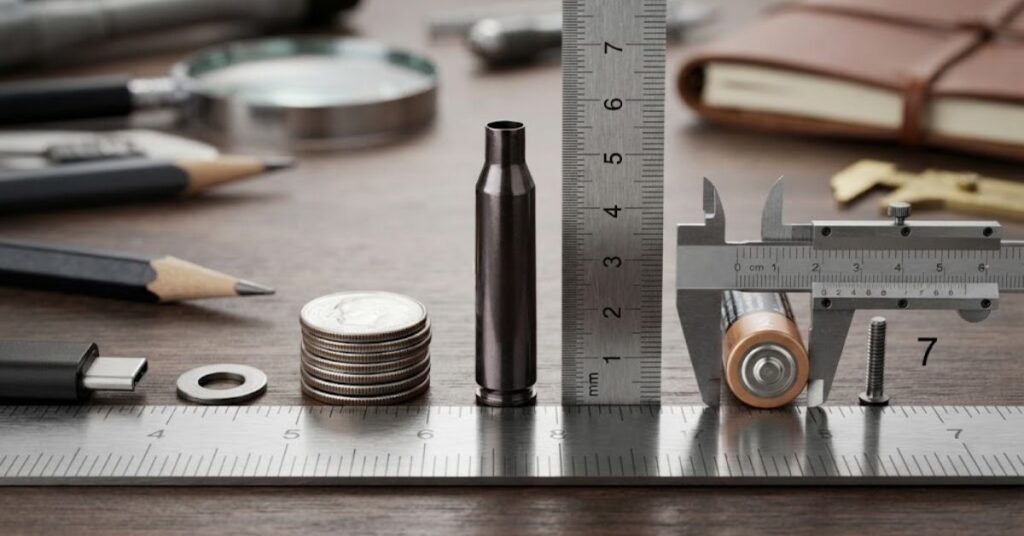
You’re shopping online and the listing says 7mm. Is that tiny, medium, or too small to even notice? Here’s the short answer: 7 millimeters equals 0.7 cm, or about 0.276 inches, which is just a hair wider than 1/4 inch.
Picture a small pea, a pencil eraser, or the head of an M4 screw. That’s your 7mm size in real life. Keep reading for nine 7mm examples, a few ruler free tricks, and a conversion chart you can bookmark.
How Big Is 7mm?
7mm sits firmly in the small measurement club. It’s a compact size, usually a little narrower than an adult’s pinky nail, and easy to overlook until it doesn’t fit.
In metric measurement terms, 7mm equals 0.7 centimeters and 0.007 meters. In feet, it’s roughly 0.023 ft, a number nobody uses on a shop floor.
The trick is building a mental picture. Think of something round, smooth and lightweight, like a pea. Once you can visualize size this way, numbers on a product page stop feeling abstract.
Ways to Measure 7mm Without a Ruler
Say you’re at a craft store and your ruler is sitting at home. It happens to everyone. You can still estimate measurement with things already in your pocket or bag.
None of these methods replace a proper measuring tool. They’ll get you close enough to make a smart call, though. Check one of them against a ruler once, and you’ll trust it for life.
Using Your Fingers

Your body is a handy measurement reference. Many adults have a little fingernail about 8 to 10mm wide, so 7mm looks slightly narrower than that nail. Measure yours once against a ruler and remember the number.
Don’t bother with fingernail thickness, by the way. A nail is only about half a millimeter thick, which is far too thin to help. Width is the number that counts.
Using Coins
A stack of coins works better than you’d think. Four US quarters stacked flat come to exactly 7.0mm, since each one is about 1.75mm thick. Five dimes give you around 6.75mm.
Prefer euros? Three 1 euro coins add up to roughly 7mm. These thin coins are handy because a coin’s thickness stays identical from one coin to the next.
Using Everyday Items

Look around your desk for everyday objects with known sizes. A standard credit card is about 0.76mm thick, so nine of them stacked land near 6.8mm. A regular hexagonal pencil measures close to 7mm across its flat sides.
Paper is another sneaky option. A sheet of ordinary 80 gsm printer paper is about 0.1mm thick. Roughly 70 sheets will give you a 7mm stack.
Quick Table of Common Things That Are 7mm Big
Here’s your conversion chart style cheat sheet. Sizes vary by brand and type, so treat these as approximate size guides. Each row is explained in detail below.
| Object | Typical Size | What It Measures |
| Pencil eraser | About 6 to 7mm | Diameter |
| Small pea | About 6 to 8mm | Diameter |
| Jewelry bead | 7mm (a less common size) | Diameter |
| Micro USB plug | About 6.85mm | Width |
| Small shirt button | About 7 to 8mm | Diameter |
| Mini marble | About 7mm | Diameter |
| M4 socket head screw | 7mm | Head diameter |
| Small wild blueberry | About 6 to 9mm | Width |
| Earbud sound opening | About 5 to 8mm | Diameter |
Pencil Eraser Thickness
Grab a standard wooden pencil and look at the pencil eraser on top. Its thickness runs about 6 to 7mm, matching the pencil body it sits on. That’s why it feels so natural in your hand.
Here’s a common mix-up. Say you order replacement erasers for a mechanical pencil and pick the wrong size. The cap is 7mm, the eraser is 5mm, and nothing clicks. A quick measurement saves a week of waiting.
Students and artists run into this all the time. If you’re shopping for drawing tools, check the barrel width first. Erasers that look identical online can differ by a full millimeter.
Small Pea

A green pea from a garden pod usually measures 6 to 8mm across. Smaller, younger peas hit that 7mm mark nicely. It’s a perfect pea-sized benchmark.
Ever read a health note that says “the size of a pea”? Doctors use that comparison because it’s easy to picture. It only works if you know what a pea really measures.
Try this at dinner. Roll a pea between your fingers and notice how it feels, smooth, round shape and symmetrical. That feeling sticks in your memory far better than a number.
Jewelry Bead
Most bracelet beads and necklace beads come in 4, 6, 8 and 10mm. A true 7mm bead exists, but it’s less common. You’ll see it in some pearls, glass beads and gemstone strands.
If you’re into handmade jewelry, size matters more than you’d expect. A 7mm bead fits comfortably on standard stringing cord. It also looks bold on earrings without weighing down your ears.
Here’s a tip for threading beads. Check the hole size as well as the bead’s outer measurement. A great 7mm bead is useless if your wire won’t slide through.
Phone Charging Pin Width
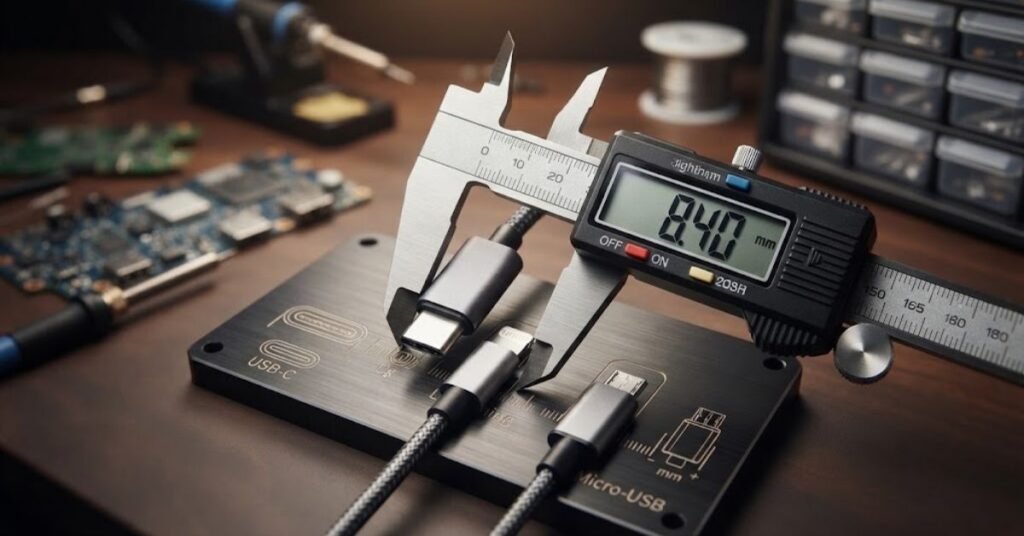
Look at the charging connector on an older Android phone. A micro USB plug is about 6.85mm wide, which is basically 7mm. Apple’s Lightning connector is a similar 6.7mm.
USB-C is a different story. It’s about 8.4mm wide and just 2.6mm thick. You can’t swap it into a 7mm charging port without a fight.
This matters when you’re buying phone accessories like cases with cutouts. A charging cable that fits one phone might not fit another. Check the port width before you order.
Standard Shirt Button Thickness
Here’s where people get tripped up. A shirt button is usually only 2 to 3mm thick, so the 7mm figure isn’t about thickness. It’s about diameter, and it applies to the smaller buttons.
A standard shirt button on a dress shirt runs about 10 to 11mm across. The smaller ones on cuffs, collars and baby clothes hover around 7 to 8mm. It’s a tiny difference that changes how a garment sits.
If you’re into sewing or tailoring, always match button size to the buttonhole. A small button in a large hole slips out. A large button in a small hole never closes.
Small Marble
A classic toy marble is about 16mm wide. That’s more than double our target. So where’s the 7mm version?
You’ll find mini marbles and small glass beads in craft materials shops. They’re popular for vases, board games and decorative crafts. Sizes vary a lot, so always check the packaging.
If your kid owns marbles, do a quick test. Drop one next to a ruler and see where it lands. Only a few will be near 7mm, and most will be bigger.
Screw Head Diameter
Screw head diameter is where 7mm really shows up. An M4 socket head cap screw has a head exactly 7mm across. That’s a standard metric size, so it’s easy to find.
DIYers see this often during furniture assembly and home improvement jobs. If your socket tools don’t fit, the head size is usually the culprit. A 7mm socket might be just what you need.
Not every screw and bolt follows the same rule. A pan head or button head on the same thread size will differ. When you head to the hardware store, bring the old screw along.
Blueberry Width
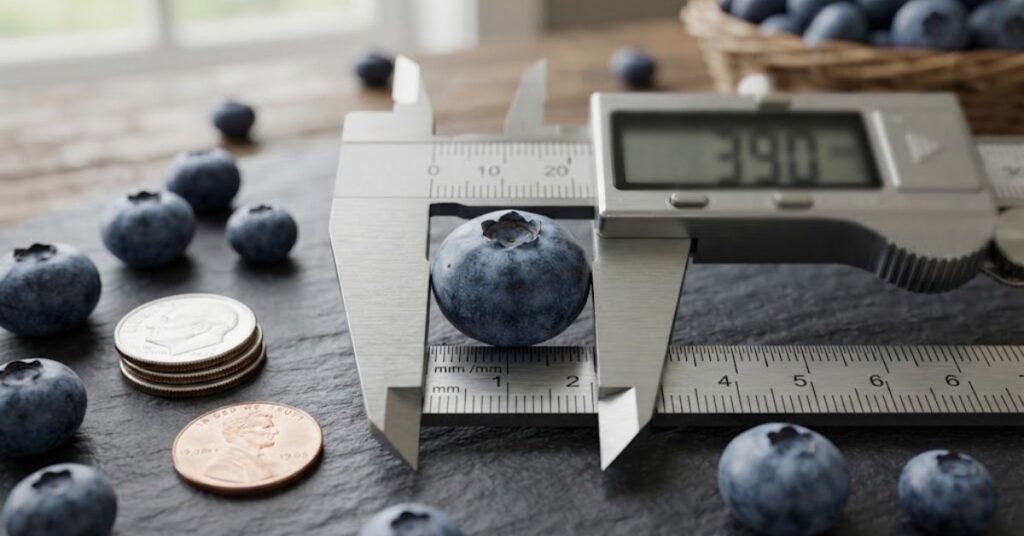
Wild blueberries are small, often 6 to 9mm across. A tiny one is a great 7mm example. Cultivated ones are much bigger, often 10 to 15mm.
Next time you’re at the market, pick out the smallest berries in the box. They’re the ones close to our target. It’s a snack and a size comparison in one.
Gardeners and cooks like this benchmark. It helps with food portions too, like judging how big a seed or a chopped piece should be. Fruit is surprisingly useful as a ruler.
Earbud Speaker Opening
Flip an earbud over and look at the speaker opening. On many models, that sound port measures somewhere between 5 and 8mm. Some sit right around 7mm.
The earbud speaker driver inside is often 6, 8 or 10mm wide. The opening and the driver are two different measurements. Mixing them up is common when shopping for replacement tips or headphones parts.
Why care? Ear tips and mesh filters need to match the opening. A poor fit hurts sound quality and lets dirt in. Measure the nozzle, not the whole bud.
7mm in Inches, Centimeters, Meters and Feet
Let’s run the unit conversions in one place. Math nerds will love this bit, and everyone else can skim. It’s a simple conversion chart you can save.
| Unit | Value for 7mm |
| Millimeters | 7 mm |
| Centimeters | 0.7 cm |
| Meters | 0.007 m |
| Inches | About 0.276 in |
| Fractional inches | Close to 9/32 in |
| Feet | About 0.023 ft |
To get inches, divide the millimeters by 25.4. So 7 divided by 25.4 gives you 0.2756. That’s why you’ll see both 0.275 inches and 0.276 inches online, depending on rounding.
One more thing people ask. A quarter inch is 6.35mm, so 7mm is a bit bigger. The closest fraction on a tape measure is 9/32 of an inch.
How 7mm Compares to 3mm, 5mm and 6mm
Sizes make more sense when you place them side by side. Things that are 3mm big include two dimes stacked together, at about 2.7mm. It’s thin enough to slide under a door.
Things that are 5mm big include a black peppercorn. Things that are 6mm big include a stack of four US pennies, at about 6.08mm, or a 1/4 inch rod at 6.35mm. Then there’s 7mm, slightly larger than all of these.
Notice how small the gaps are. One millimeter separates a snug fit from a loose one. That’s why precision matters in repair work.
Related Inch Comparisons
Sometimes you jump from millimeters to bigger numbers. You might wonder how long is 3 inches, how long is 5 inches, or how long is 10 inches. Here’s a quick guide in millimeters.
| Inches | Millimeters |
| 3 inches | 76.2 mm |
| 4 inches | 101.6 mm |
| 5 inches | 127 mm |
| 6 inches | 152.4 mm |
| 7 inches | 177.8 mm |
| 8 inches | 203.2 mm |
| 9 inches | 228.6 mm |
| 10 inches | 254 mm |
| 12 inches | 304.8 mm |
| 15 inches | 381 mm |
| 20 inches | 508 mm |
Fun fact: a 7 inch tablet screen is about 178mm diagonally. That’s more than 25 times the size of our little 7mm pea. Scale changes everything.
Why Knowing 7mm Actually Helps
Small numbers cause big headaches. Online shopping is the classic example. A ring stone, a phone case cutout or a watch strap can be off by 1mm and ruin the fit.
It also helps with crafting, decorating and home repairs. You’ll pick the right drill bit, the right bead and the right screw on the first try. That saves you money and a trip back to the store.
Even kids benefit. School supplies and learning measurements click faster when you use familiar objects. A pea teaches more than a worksheet ever could.
Conclusion
So, how big is 7mm? It’s 0.7 cm, about 0.276 inches, and just larger than a quarter inch. Think small pea, pencil eraser, M4 screw head, or micro USB plug.Now you’ve got real-world examples and simple tricks for everyday comparisons. Keep a stack of coins or a credit card handy for a quick check. For anything that needs exact dimensions, use a real ruler or caliper.
Have you spotted something else that’s 7mm? Drop it in the comments and tell us. And if this guide saved you a trip to the store, share it with a friend who’s always asking about sizes.
FAQs
Is 7mm bigger than 1/4 inch?
Yes, it is. A 1/4 inch equals 6.35mm, so 7mm is about 0.65mm larger. That’s small, but enough to matter on tight-fitting parts.
What does 7mm look like?
Picture a small green pea, a pencil eraser or the head of an M4 screw. It’s roughly the width of a micro USB plug. Most people find it clearer than a ruler tick.
How can I measure 7mm without a ruler?
Stack four US quarters flat, and you get exactly 7.0mm. You can also use nine credit cards, three 1 euro coins or about 70 sheets of printer paper. Each method gets you close.
Is 7mm considered small?
For everyday objects, yes. It’s tiny, but still visible and easy to handle. In electronics, though, a phone 7mm thick is considered very slim, so context decides.
What objects are around 7mm?
Common ones include a pencil eraser, a small pea, an M4 screw head, a micro USB plug, a small wild blueberry and a 7mm jewelry bead. Small shirt buttons and mini marbles land in the same zone. Always check the exact size before buying.

Ethan Whitmore is the editor and administrator of Stylovix, dedicated to making measurements, conversions, sizes, and dimensions simple, accurate, and easy to understand.
