

Ever stared at a product page and wondered if 50 inches will actually fit your space? Or tried to picture a length in your head and come up blank?Here’s the short answer. 50 inches equals 4 feet 2 inches, or 127 centimeters. That’s about the width of a large TV, a roomy bench, or a compact sofa.Maybe you’re shopping for a desk for a small apartment.
Maybe you’re checking if a coffee table will crowd your living room. Or maybe you just want to eyeball a length without a measuring tape.This guide covers 13 everyday things that run about 50 inches. You’ll also get a quick table, real size tips, and easy ways to estimate the length by eye.
How Long Is 50 Inches?
50 inches is 4 feet 2 inches long.
That makes it 2 inches longer than 4 feet and 10 inches shorter than 5 feet.
Picture a standard interior door, which stands about 80 inches tall.
That length reaches about five eighths of the way up.
To do an inch to feet conversion, divide the inches by 12.
To get centimeters, multiply by 2.54.
Here’s a handy reference for the units you’ll use most.
| Unit | 50 Inches Equals |
| Feet and inches | 4 ft 2 in |
| Decimal feet | 4.17 ft |
| Centimeters | 127 cm |
| Millimeters | 1,270 mm |
| Meters | 1.27 m |
| Yards | 1.39 yd |
Quick Comparison Table
Not every item below is exactly 50 inches.
Most land within a few inches, because standard furniture dimensions come in a range.
| # | Item | Typical Measurement | Note |
| 1 | 50-Inch TV Width | About 43.6 in (50 inch screen), about 50 in (58 inch screen) | Screen size is a diagonal |
| 2 | Standard Bench Length | 48 to 50 in | Seats two to three |
| 3 | Large Coffee Table Length | 48 to 54 in | Suits a 75 in sofa |
| 4 | Office Desk Length | 48 to 60 in | Fits a laptop and monitor |
| 5 | Kitchen Island Width | 48 to 60 in | Seats two stools |
| 6 | Sofa Seat Width (Compact) | About 50 to 60 in | Small loveseats and settees |
| 7 | Bookshelf Width | 48 to 50 in | Watch for sagging shelves |
| 8 | Large Dog Crate Length | 48 in crate, close to 50 in outer length | For large breeds |
| 9 | Window Width (Large Size) | 48 to 72 in | Check the rough opening |
| 10 | Dining Table Width (Small) | 48 to 50 in | Round table diameter |
| 11 | Storage Cabinet Width | 48 to 50 in | Leave room on each side |
| 12 | Wall Mirror Width | 48 to 50 in | Pairs with a 67 to 75 in console |
| 13 | Bed Frame Width (Full Size Approx.) | Full mattress is 54 in | Frame adds a few inches |
1. 50-Inch TV Width
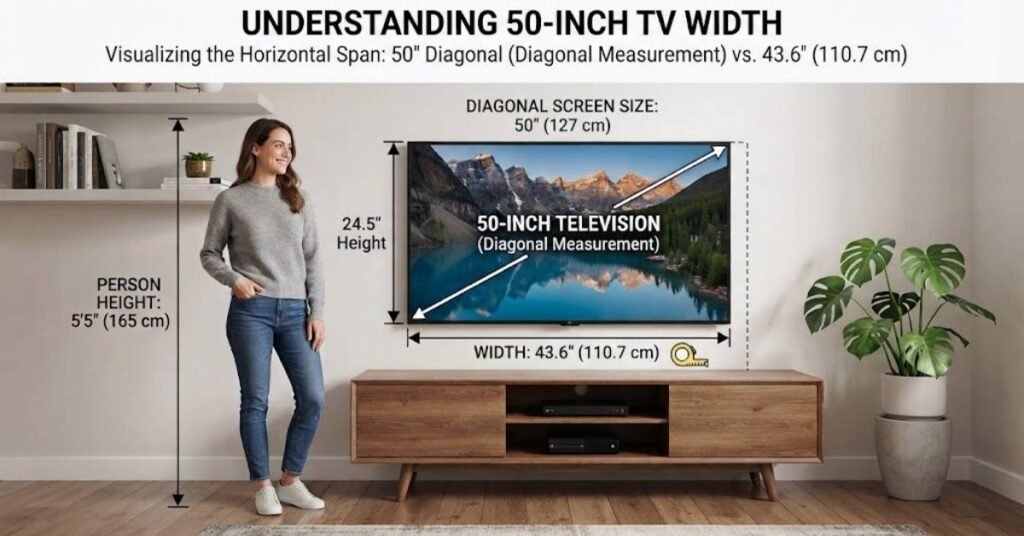
Here’s where people get tripped up.
A “50-inch TV” is measured on the diagonal, from one corner of the screen to the opposite corner.
The real width is closer to 43.6 inches, and the height is about 24.5 inches.
To find the width of any 16:9 TV, multiply the diagonal screen size by 0.872.
That puts a 57 or 58 inch TV right around that width.
Check your TV stand before you buy.
A stand a little over 4 feet wide suits a 55 inch TV, which measures roughly 48 inches across.
2. Standard Bench Length
A bench about 4 feet 2 inches long is a favorite for entryways, mudrooms, and the foot of a bed.
It’s just a bit longer than the common 4 foot bench.
Two adults sit on it comfortably, and three can squeeze in for a short stop.
Plan on about 20 to 24 inches of seat width per person.
Measure your door swing before you commit to a bench in a tight entry.
A bench that blocks the door will annoy you every single day.
3. Large Coffee Table Length
Large coffee tables often run 48 to 54 inches long, so a 50 inch model sits right in the middle.
It’s a roomy centerpiece for a living room that hosts four to six people.
One simple design rule helps here.
Your table should be about two thirds the length of your sofa.
That makes this size a strong match for a sofa around 75 inches wide.
Keep roughly 14 to 18 inches between the table and the sofa.
You’ll reach your drink easily and still walk through the room.
4. Office Desk Length
A 50 inch desk hits a sweet spot for home offices.
It holds a laptop, a monitor, and a notebook without swallowing the room.
Depth matters as much as length.
Look for 24 to 30 inches of depth so your monitor sits at a comfortable distance.
Most standard desks stand about 29 to 30 inches tall.
Running two monitors?
Two 24 inch screens take up about 42 inches of width, which leaves little elbow room on that surface.
5. Kitchen Island Width
Compact islands often measure about 4 feet 2 inches long.
That suits galley kitchens and small open plan spaces.
Clearance counts more than island size.
Kitchen design guidelines from the National Kitchen & Bath Association suggest about 42 inches of aisle space for one cook and 48 inches for two.
Allow around 24 inches of counter length per seat.
So a 50 inch island seats two people with room to spare.
6. Sofa Seat Width (Compact)
Compact sofas, small loveseats, and apartment settees often start around 4 feet 2 inches wide.
They fit neatly under a window or at the end of a bed.
That width seats two adults at roughly 24 inches each.
It won’t handle a full family movie night, but it works well where floor space is tight.
Measure the doorway, stairwell, and elevator too, not just the room.
Even a compact sofa needs a clear path to get inside.
7. Bookshelf Width
Many bookcases run 48 to 50 inches wide.
They hold plenty of books and give a wall a built in look.
Here’s the catch.
Long shelves can sag under heavy books.
Many woodworkers keep shelf spans closer to 30 to 36 inches when using 3/4 inch boards.
If you own a 50 inch bookshelf, add a center support or a thicker shelf board.
Stack your heaviest hardbacks near the vertical sides.
8. Large Dog Crate Length
A 48 inch crate is the standard size for large breeds, usually dogs around 70 to 90 pounds.
Once you count the frame and latches, the outer length often lands close to that mark.
To pick the right size, measure your dog from nose to the base of the tail.
Then add 2 to 4 inches.
Your dog should stand, turn around, and lie down without trouble.
Also check the floor space, since the crate door needs room to swing open fully.
9. Window Width (Large Size)
Large sliding and picture windows often span 48 to 72 inches.
That makes this a common mid to large size.
Watch the wording on product listings.
Some show the frame size, and others show the rough opening, which is usually a little larger, often by about half an inch.
Measure the width at the top, middle, and bottom, then use the smallest number.
For curtains, a rod that extends 3 to 6 inches past each side lets in more light.
10. Dining Table Width (Small)
Here, 50 inches means the diameter of a small round table or the long side of a compact rectangular one.
Both work well in small apartments and breakfast nooks.
A 48 inch round table seats four comfortably and five in a pinch.
Round shapes also help traffic flow, since there are no sharp corners.
Leave about 36 inches between the table edge and the nearest wall.
That gives chairs enough room to slide back.
11. Storage Cabinet Width
Storage cabinets, credenzas, and garage units commonly come in 48 to 50 inch widths.
Two doors and an adjustable shelf are typical.
Leave at least an inch on each side when you measure your space.
It makes sliding the cabinet into place much easier.
Anchor tall cabinets to the wall for safety.
And check the shelf weight rating before you load it up.
12. Wall Mirror Width
A mirror about 50 inches wide makes a bold statement above a console, sideboard, or fireplace.
It also bounces light around a dim room.
A handy rule says the mirror should be about two thirds to three fourths the width of the furniture below it.
That means a mirror this size pairs well with a console roughly 67 to 75 inches wide.
Hang it so the center sits near eye level, around 57 inches from the floor.
Use wall anchors rated for the weight.
13. Bed Frame Width (Full Size Approx.)
Bed sizes sit close to this length, but they don’t hit it exactly.
A full mattress is 54 inches wide, and a twin is 38 inches.
So this size lands between the two.
Frames add width too, usually a few extra inches.
Plan your floor space around the frame, not just the mattress.
Here’s a fun fact.
A standard US crib mattress is about 51 5/8 inches long, so it’s another bed that lands near that length.
Small Things That Add Up to About 50 Inches
Sometimes you don’t have furniture handy.
These small everyday objects can help you build a 50 inch line on the floor.
- 8 US dollar bills end to end: about 49 inches, since each bill is 6.14 inches long
- 15 credit or ATM cards in a row: about 50.5 inches, at 3.37 inches each
- 6 standard bricks: about 48 inches, at roughly 8 inches each
- 3 cinder blocks: about 48 inches, at roughly 16 inches each
- An 88 key piano keyboard: usually 48 to 52 inches wide
How to Estimate 50 Inches Without a Ruler
You don’t always need a measuring tape.
A few simple tricks get you close enough for a quick decision.
- Yardstick plus ruler: 36 inches plus 12 inches gets you to 48, then add 2 more
- Letter paper: 4 and a half sheets laid long edge to long edge equal about 49.5 inches
- Floor tiles: four 12 inch tiles plus a small gap
- Kitchen counter: a standard counter stands 36 inches high, so this length is about 14 inches taller
- Your hand span: check yours against a ruler once, then count spans
Quick math beats guessing.
Four 12 inch rulers equal 48 inches, so add two more inches and you’re there.
Size Mistakes to Avoid Before You Buy
A few small slips cause most returns.
Watch out for these.
- Mixing up diagonal and width: TV sizes describe the diagonal, not the real width
- Ignoring depth: a 50 inch desk or cabinet still needs the right depth
- Skipping clearance: leave walking room around islands, tables, and beds
- Forgetting the path: doors, halls, and stairs must fit the item too
Conclusion
50 inches is a friendly, practical length. It’s 4 feet 2 inches, or 127 centimeters, and it shows up in TVs, desks, benches, mirrors, cabinets, and more.Remember that some items are close to this length rather than exact.
Always check the product dimensions and measure your space before you buy.Got a favorite 50 inch object that we missed? Drop it in the comments below. And if this guide helped, share it with a friend who’s about to buy furniture.
FAQs
How long is 50 inches in feet?
50 inches equals 4 feet 2 inches, or about 4.17 feet.
How long is 50 inches in centimeters?
50 inches equals 127 centimeters, since each inch is 2.54 cm.
Is 50 inches a common measurement?
Yes, it’s common for furniture and home goods like desks, benches, and mirrors.
TVs use it too, but as a diagonal size.
What objects are 50 inches long?
Common examples include large coffee tables, office desks, compact sofas, bookshelves, wall mirrors, and a 57 or 58 inch TV’s width.
How can I estimate 50 inches without a ruler?
Combine a yardstick (36 inches), a 12 inch ruler, and 2 more inches.
You can also line up eight US dollar bills end to end.

Ethan Whitmore is the editor and administrator of Stylovix, dedicated to making measurements, conversions, sizes, and dimensions simple, accurate, and easy to understand.
